Arne O. Holm says The Dramatic Battle Over Defense Expenses Is About Much More Than Money
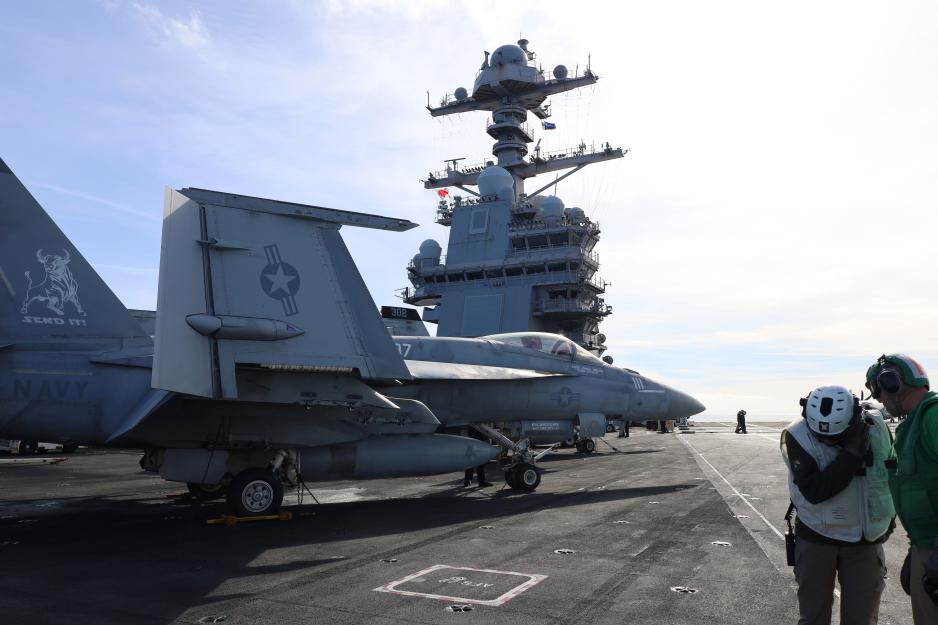
An F-18 prepares for flight on the aircraft carrier USS Gerald R. Ford. (Photo: Hilde-Gunn Bye / High North News)
Comment: Right now, a dramatic battle is taking place within the EU about the continued funding of Ukraine's defense against an increasingly aggressive Russia. However, this is not just about money, but largely also about the voters' continued trust in their leaders.

This comment is written by a member of the editorial staff. All views expressed are the author's own.
So far, European governments have managed to shield their inhabitants to a certain degree from the enormous cost of the war. They have managed to do so by using savings from funds or by taking out loans. The costs have only impacted voters directly in extraordinary cases.
Public holiday
Last year, Denmark removed a public holiday, Store Bededag, as a direct consequence of increased defense expenses. Finland, France, and Germany are also considering similar measures.
Several countries are considering major, and in the opinion of the authorities, necessary cuts or restrictions in public welfare.
In Norway, the Oil Fund ensures that the state budget is balanced without having had major consequences for its inhabitants so far.
Today, the EU Commission's President, Ursula von der Leyen, the German Chancellor Friedrich Merz, and Belgium's Prime Minister Bart de Wever are meeting for what is described as an 'emergency talk'.
The emergence of far-right forces shows that the trust has been broken.
Put simply, it is about finding out whether and how frozen Russian assets can be used for the much-needed financing of Ukraine's war resistance over the next two years.
Belgium, which is currently controlling these assets, believes it is too risky to contribute to such a solution. The alternative, if Ukraine is to have any chance at all to survive as an independent nation, is for the EU countries to take out new enormous loans.
While Europe must contribute to Ukraine's economy, the countries' individual defense budgets are also increasing by sums that can hardly be covered.
Additional currency
The defense expenses are exploding, even for the oil nation of Norway. Just the planned purchases of submarines, frigates, and fighter jets will cost about NOK 350 billion. Measured against next year's state budget, this comprises about 15 percent of the total state expenses, if everything were to be paid at once.
But this is not just about money. There is an additional currency that can't be converted into either kroner or dollars.
That currency is political trust, and it is crucial for European countries to conduct necessary cuts to reach their military objectives.
Perhaps it's time to step out of the sandbox?
We know little of how fragile the trust between politicians and voters is. The emergence of far-right forces in several European countries signals that trust is breaking down.
We also know that Russia's hybrid warfare has as its primary goal to shake what we like to call the social contract between the voters and elected officials, for example, through the past months' almost hysterical reports of drones around European airports.
Breaking from the inside
In the USA, this contract has already been torn to pieces. Donald Trump uses his presidential seat to break down the trust from the inside.
The more symbolic austerity measures, like abolishing public holidays, will be replaced by much more drastic measures in the coming years.
Today's budget negotiations will look like child's play compared to what we have in store.
Perhaps, then, we must step out of the sandbox and instead prepare for what's ahead. That is the only way to maintain the necessary trust.