EU Spent €7.2 Billion On Russian LNG in 2025, Maximizing Imports Before 2027 Ban
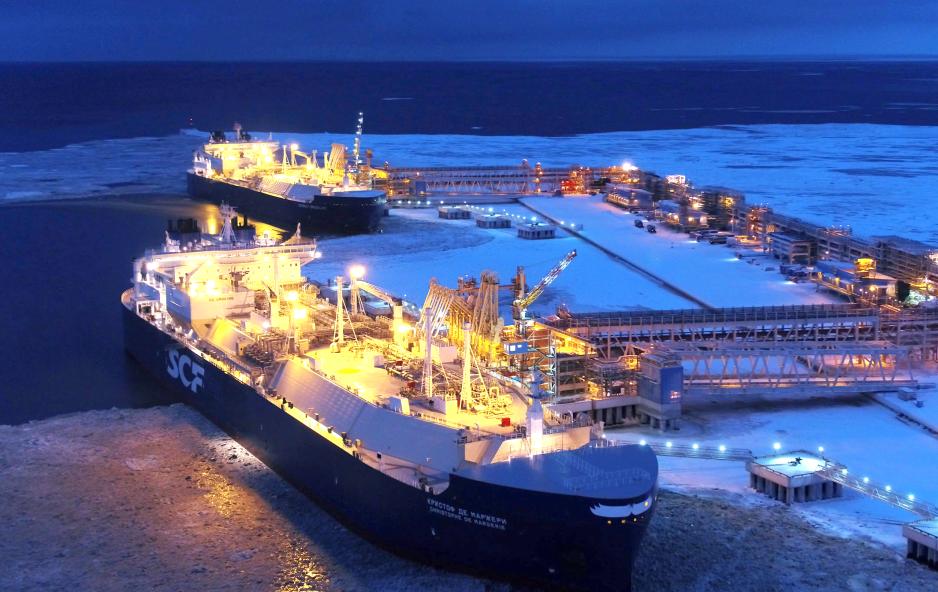
Arc7 LNG carriers loading liquefied natural gas at the port of Sabetta. (Source: Novatek)
Europe keeps buying Russian fuel without any noticeable slowdown with less than 12 months remaining before an EU ban on the import of Russian LNG takes effect. Highlighting the ineffectiveness of existing EU half-measures, including the transshipment ban, Belgium more than doubled its imports from Yamal LNG in 2025, simply keeping LNG once the re-export ban took effect.

The European Union spent about 7.2 billion Euro ($7.8 billion) on Russian liquefied natural gas in 2025, keeping imports from the Kremlin’s Arctic flagship Yamal LNG project flowing at an unrelenting pace despite an agreed ban that will take effect on Jan. 1, 2027, according to analysis by campaign group Urgewald.
The figures, based on Kpler data, underscore how EU buyers appear determined to squeeze every possible cargo out of Yamal LNG before the deadline, even as Brussels touts its political commitment to phase out Russian gas and curb Moscow’s revenues from energy exports following its invasion of Ukraine.
Data compiled by Kpler and analyzed by Urgewald show that EU imports from Yamal LNG in 2025 remained close to record levels and were broadly in line with 2024, when spending on Russian LNG already stood well above pre-war norms.
The 2025 figure is up from roughly €6.3 billion in 2024, highlighting how LNG imports have become an increasingly important outlet for Russian gas as pipeline deliveries collapsed.
“While Brussels celebrates the latest agreement to phase out Russian gas, our ports continue serving as the logistics lung for Russia’s largest LNG terminal Yamal. In the current geopolitical situation, we cannot afford another year of complicity,” said Sebastian Rötters, sanctions campaigner at Urgewald.
Our ports continue serving as the logistics lung for Russia’s largest LNG terminal Yamal
The Yamal LNG project, located in Russia’s Arctic and majority-owned by Novatek with foreign partners, has become a cornerstone of Moscow’s gas export strategy. With pipelines to Europe largely shut, LNG cargoes shipped from Yamal have continued to find willing buyers in the EU, benefiting from the absence of a full import ban until 2027.
France has emerged as the bloc’s largest buyer, accounting for 41.7% of EU imports from Yamal LNG through its two main terminals, Dunkirk and Montoir-de-Bretagne, Urgewald said.
Spain, Belgium and the Netherlands were also among the major recipients.
Transshipment ban resulted in more imports
In some respects, partial EU measures have even made matters worse, campaigners argue. A ban on transshipment of Russian LNG via EU ports, designed to prevent cargoes being re-exported onward to third countries, took effect in March 2025.
Before that, Belgium’s Zeebrugge terminal served as a key hub for transferring Yamal LNG cargoes to non-EU destinations.
Also read (the text continues)
Instead of reducing volumes, the ban appears to have altered trade flows in an unintended way. Zeebrugge did not cut the number of cargoes it received after the transshipment ban came into force.
Rather, it shifted from re-exporting them to keeping them inside the EU.
“The EU’s ban on transshipments of Russian LNG that came into effect in March 2025 contributed to various European LNG terminals increasing their imports of LNG from Russia’s Yamal terminal,” explains Ana Maria Jaller-Makarewicz, Lead Energy Analyst for Europe at IEEFA, a global think tank examining issues related to energy markets, trends, and policies.
In 2024 Zeebrugge received 6.13 bcm of Russian LNG and re-exported 3.4 bcm, with around 2.7 bcm remaining in the EU, the data show. In 2025 the import figure more than doubled.
“Belgium’s Zeebrugge LNG terminal doubled its imports of LNG from Russia's Yamal terminal from 2.7 bcm in 2024 to 5.5 bcm in 2025,” Jaller-Makarewicz confirms.
A similar trend can be observed at one of France’s main terminals. “France’s Montoir-de-Bretagne LNG terminal increased its imports of LNG from Russia's Yamal terminal by 26% from 2.9 bcm in 2024 to 3.6 bcm in 2025,” she continued.
We are not just customers
The scale of those imports is stark. In 2025, Zeebrugge alone received 4.6 million tonnes of Yamal LNG, more than the 3.6 million tonnes imported by all of China over the same period, Urgewald said.
Too many loopholes
Campaigners say the pattern illustrates how Russia has been able to exploit loopholes left by partial sanctions and incremental measures, maintaining strong cash flows from LNG exports even as the EU seeks to project a tougher stance.
“We are not just customers; we are the essential infrastructure keeping this flagship project alive. Every cargo that offloads at an EU terminal is a direct deposit into a war chest that fuels the slaughter in Ukraine. We must stop providing the oxygen for Russia’s energy profits and shut the Yamal loophole now,” Rötters said.
EU officials argue that the delayed ban was necessary to avoid energy supply shocks and price spikes, particularly after the bloc scrambled to replace Russian pipeline gas with LNG following the start of the war. They also point to record investments in renewables and energy efficiency, as well as declining overall gas consumption.
Critics counter that continuing to import Russian LNG until the last possible moment undermines the bloc’s credibility and dilutes the impact of sanctions, while handing Moscow billions of euros in revenue during the war.
With the 2027 deadline still a year away, the data suggest that unless policy changes, Europe’s appetite for Yamal LNG will remain strong, and Russia’s flagship Arctic gas project will keep pumping cargoes into EU ports until the clock finally runs out.