The Arctic Scientist Profiles: Stig (30) Has Researched Snow in Svalbard for Four Years: “I Don’t Even Ski!”
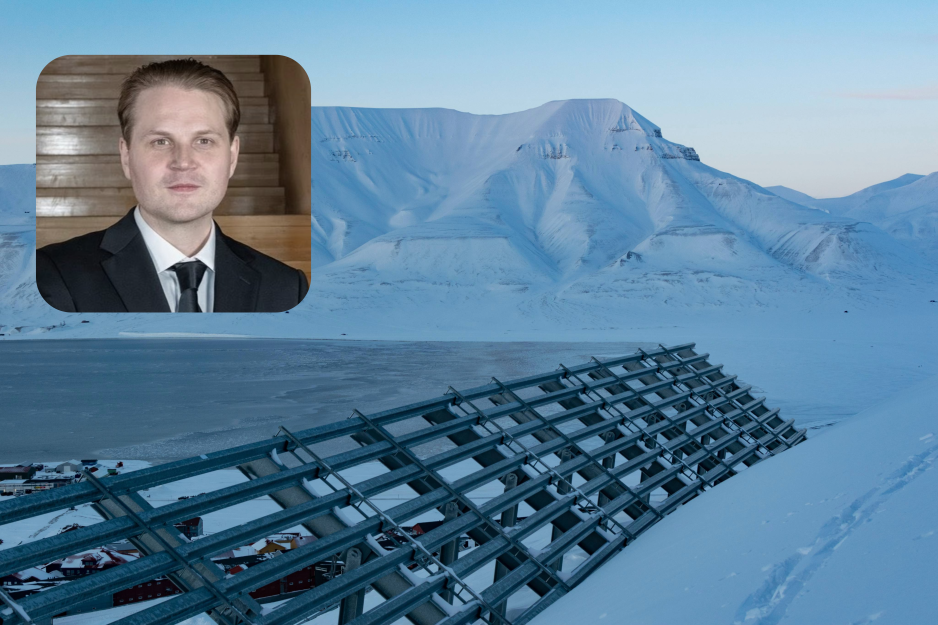
Stig Andreas Johannessen has researched short and long-term measures against climate-related risks in Svalbard. (Background photo of support structures at Sukkertoppen: Holt John Hancock. Photo of Stig: Ingrid Ballari Nilssen)
Stig Andreas Johannessen (30) became the first to defend his dissertation in Arctic Security at UNIS, the University Center in Svalbard. He has researched how Longyearbyen manages climate-related risks while simultaneously experiencing how climate change impacts the island himself.

After six months on Svalbard, Stig Andreas Johannessen (30) from Stavanger was captivated by the Arctic. He knew he had to return to the archipelago, which he did in 2021 to embark on a PhD at UNIS, in cooperation with the Faculty of Economics and Management at NTNU in Trondheim.
Four years later, he became the first to defend a dissertation in Arctic Security, the newest field of study at UNIS.
His dissertation is titled "Lessons from Longyearbyen on climate-related risk governance" and focuses on how Longyearbyen manages and adapts to climate-related risks, such as avalanches and slush flows.
Johannessen has seen with his own eyes how the climate in the Arctic is changing.
"It was crazy to see the major changes that had taken place when I returned to Svalbard after a year," he says to High North News.
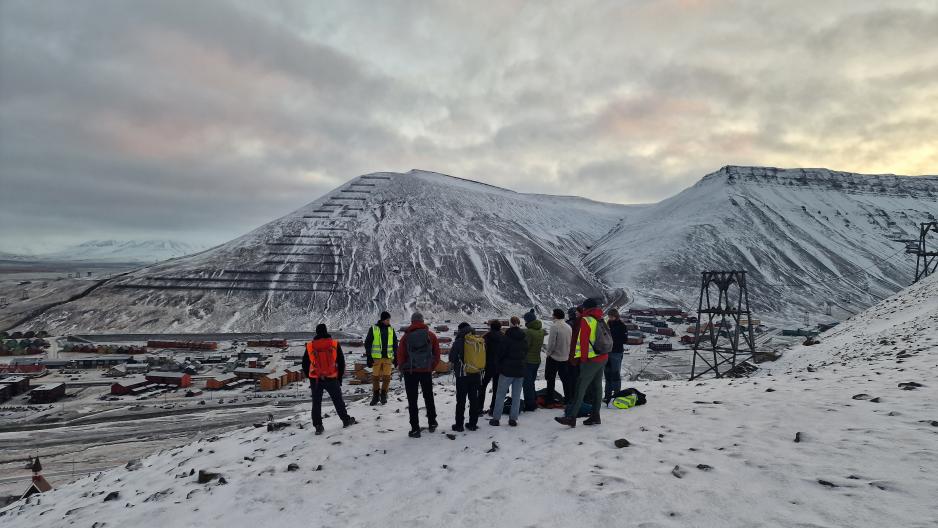
Photo of Sukkertoppen and Vannledningsdalen taken during field teaching in October 2022. (Photo: Stig Andreas Johannessen)
Johannessen has a bachelor's degree in comparative politics from the University of Bergen and a master's degree in societal security from the University of Stavanger.
It was during his master's degree that the researcher spent six months in Svalbard. For the first time, he got the feeling that he could do a PhD during a preparedness course on the archipelago.
After graduating, he applied for a position at UNIS. But he didn't hear back and instead embarked on psychology studies. However, two days before Christmas, he got an interview and eventually landed the position.
Measures against avalanches in Longyearbyen
The researcher didn't have any clear interest in climate and climate management before starting his PhD.
"I had looked into health security and security within information systems. But seeing how climate change had impacted Longyearbyen in such a short amount of time was eye-opening," says Johannessen.
"Longyearbyen has had to manage climate change for a long time. They conduct long-term measures such as relocating housing units, avalanche fences, snow fences, and slope stabilisation nets, and short-term solutions such as closing roads and evacuating when there is an acute avalanche risk."
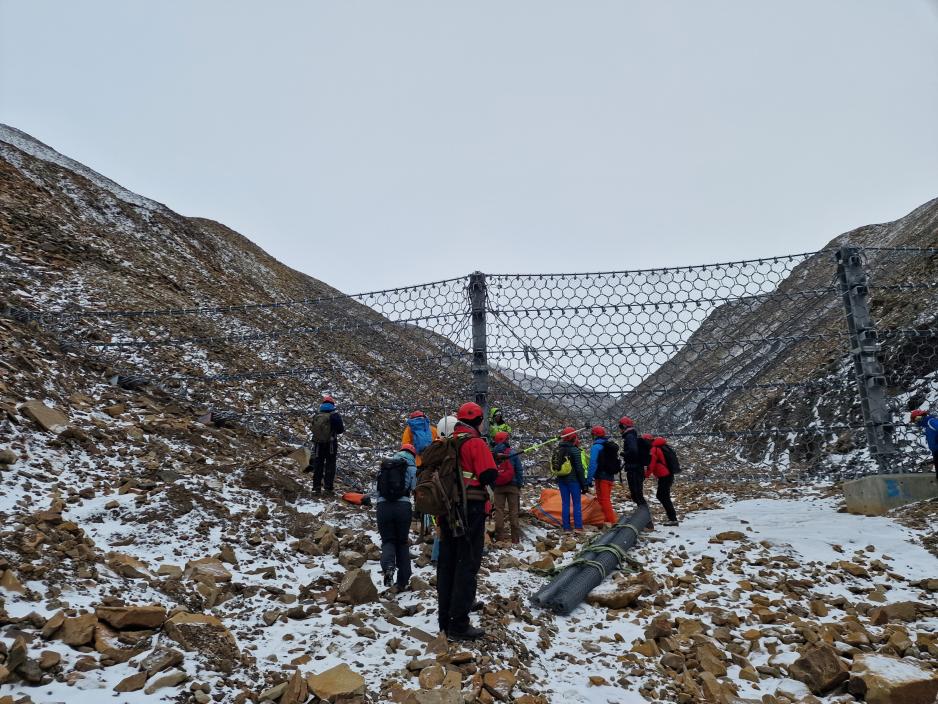
The photo shows a slope stabilisation net in Longyearbyen during the International Snow Science Conference 2024's excursion to the archipelago. (Photo: Stig Andreas Johannessen)
Local knowledge
Johannessen highlights several important findings, including the use of local knowledge.
"Local knowledge is central to understanding avalanches. Everyone we met spoke of local knowledge, but it was difficult to know what that entailed," he says and continues:
"We figured out that there are several forms of tacit knowledge. One was the situational knowledge only available to those who live in Longyearbyen and who experience and discuss snow with their colleagues and others."
Another form was bodily knowledge. Johannessen says the lives of the people who do snow observations on Svalbard revolve around snow. They either ski, ride snowmobiles, or work with snow.
"They had a feel for snow. Walking the same mountainside over and over again makes you understand the snow cover and the snow layers and how wind and weather variations can affect all of this."
The third form of knowledge was synthetic, being able to combine the bodily and situational knowledge with the formal knowledge over time.
"My research contributes to the understanding of the significance of local knowledge," the researcher adds.
Evacuation
He has also researched the main characteristics of the evacuation communication in Svalbard, Honningsvåg (Northern Norway), Rauma (Western Norway), and Uummannaq (Greenland).
"We found that these different environments face an array of different natural dangers, but they manage them in the same way. They use scientific monitoring, continuous communication, and relocation of people," explains the researcher.
"Successful evacuations are dependent on the facilitation of efficient and robust relationships between those who are evacuated and those who evacuate. It's about building bridges between the personal and the scientific ownership that people have to the place and the phenomenon," he says.
And there were differences in personal ownership. There is major turnover in Longyearbyen, in contrast to Rauma and Uummannaq.
"Their identity is highly linked to the place. The same people and families have lived there for many, many generations. Evacuating these people, or moving them in the worst-case scenario, has bigger consequences than decision-makers can take into account."
Johannessen adds that it was important for those who were evacuated to feel heard and that people understood how much it meant. And if they were, it wasn't that bad to be evacuated for a longer time, and time and time again.
"It was important to be open to the possibility that people living in the area know the phenomenon as well as those who have many years of training and who use simulations," explains the researcher.
It is a type of knowledge only available to those who live in Longyearbyen.
Compact Longyearbyen
What kind of challenges or opportunities have you seen in terms of the interaction between researchers, inhabitants and authorities when it comes to risk management in Longyearbyen?
"We were lucky to get as many as we did involved in the project. Longyearbyen has a severe case of informant fatigue and professional informants. People are tired of being asked the same questions again and again," replies Johannessen and continues:
"They won't talk to you if they don't feel that you have some form of legitimacy or that you won't contribute. In addition, there is a high turnover of people, so all of my informants eventually moved."
"However, an opportunity is that everyone is in Longyearbyen. If they feel that you can contribute, they are very willing. Telenor Svalbard was of great help, for example. There aren't many major barriers there, as there can be on the mainland, and you get all the resources you need to implement measures in Svalbard."
After major avalanches in 2015 and 2017, Norway invested about NOK 350 million in avalanche management in Svalbard, which has not happened in any other municipality in Norway, says the researcher.
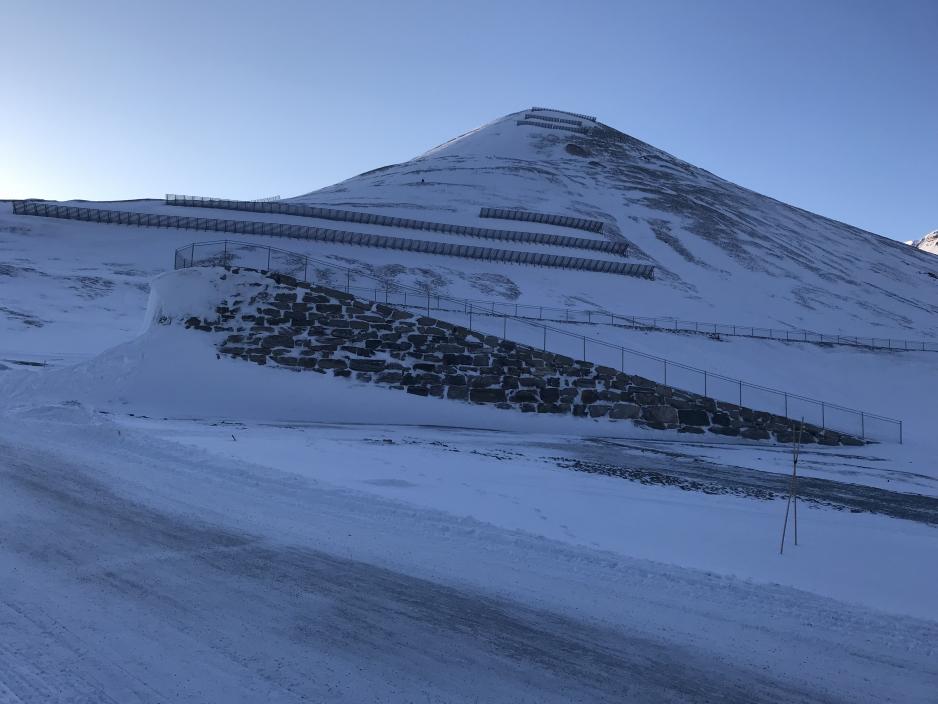
Measures against avalanches in front of Sukkertoppen in Svalbard. (Photo: Eirik Albrechtsen)
UNIS, the ivory tower
Did being from UNIS help alleviate informant fatigue? Did it provide legitimacy to come from an institution that belongs in Svalbard?
"No, that's not always the case. Longyearbyen is a class society and is divided into social groups. There can sometimes be a perception of UNIS as an ivory tower and that the people there are difficult to deal with," replies Johannessen, and continues:
"Therefore, we benefited greatly from being an interdisciplinary project, with good local roots. We could combine nature and social science in an applied and understandable way to solve problems in Longyearbyen."
Johannessen would also feel how difficult it was to maintain a work-life balance in a society like Longyearbyen.
"You meet all your informants, students, and all of your colleagues everywhere. My life revolved around snow, and I don't even ski! So one of the chapters in the dissertation is actually titled Don't talk to me about snow," the researcher laughs.
The 'Svalbard type'
Through his PhD, Johannessen was able to experience Svalbard over a longer period of time. The archipelago's nature and the social student life were what attracted him at first. But now, the researcher is enjoying a break from the island.
"I have no need to live there, but I am happy to visit. I teach there for one week during the school year, and I have good relations with the people who work there."
"However, many of the people who are attracted to Svalbard, especially in my age group, are spontaneous and adventurous. They are often a bit disorganized and that is the opposite of me. That could be hard to deal with at times," chuckles Johannessen.
After defending his dissertation this fall, Johannessen has moved to Trondheim and is working as a Postdoctoral Fellow in sociology at the Norwegian University of Science and Technology (NTNU), where he is working with algorithms and artificial intelligence, among other things.