Norway to Expand Submarine Fleet With Two Additional German-Built Boats to Counter Rising Russian Threat

German-Norwegian Type 212 submarine. (Source: Courtesy Germany Navy)
The Norwegian government supports the acquisition of two additional submarines from Germany, boosting its order with Thyssenkrupp Marine Systems (TKMS) to six boats; a move intended to strengthen Norway’s deterrence and surveillance capacity in the North Atlantic and Barents Sea.

The government of Norway announced on December 5, 2025, that it plans to exercise an option to acquire two additional Type 212CD submarines built by German shipbuilder TKMS, raising the total order from four to six.
“Norway is a coastal and maritime nation, and submarines are absolutely central to the defense of our country,” Defense Minister Tore O. Sandvik said.
“We see that the activity of Russian forces in the North Atlantic and the Barents Sea has increased. As NATO’s eyes and ears in the north, this places greater demands on our ability to demonstrate presence, monitor and deter in our immediate areas. In that context, submarines are absolutely indispensable,” he continued.
Expanding from 4 to 6 submarines
Norway had originally signed a four-submarine contract under the joint German-Norwegian Type 212CD programme, with two boats already under construction in Germany and an initial delivery scheduled for 2029.
The new proposal submitted to the national parliament (the Storting) seeks to expand that fleet by two more vessels.
We are in a very serious security situation
According to Sandvik, “the Chief of Defence has given a clear recommendation to acquire six submarines. With six submarines, the Defence Forces will be able to operate more vessels in more places at any time. This will have a strong deterrent effect on a potential adversary. It will also help strengthen NATO’s overall ability to ensure control and defence in the North Atlantic and the High North.”
A serious situation
The two additional submarines come at a significant financial cost: the expansion will increase the submarine program’s budget by NOK 46 billion (about €3.9 billion), partly to finance a second production line at the German shipyard needed to deliver the boats quickly enough.
The additional funds will also cover rising costs due to strained supply, rising equipment costs, and the weakened Norwegian krone.
Sandvik underscored the logic behind the timing:
“We are in a very serious security situation. Norway and our allies must strengthen their defense capabilities, while the prices of defense equipment are increasing.
The government believes that it is right to prioritize the acquisition of two additional submarines now. It is an expensive investment, but also an important investment in securing Norway in turbulent times.”
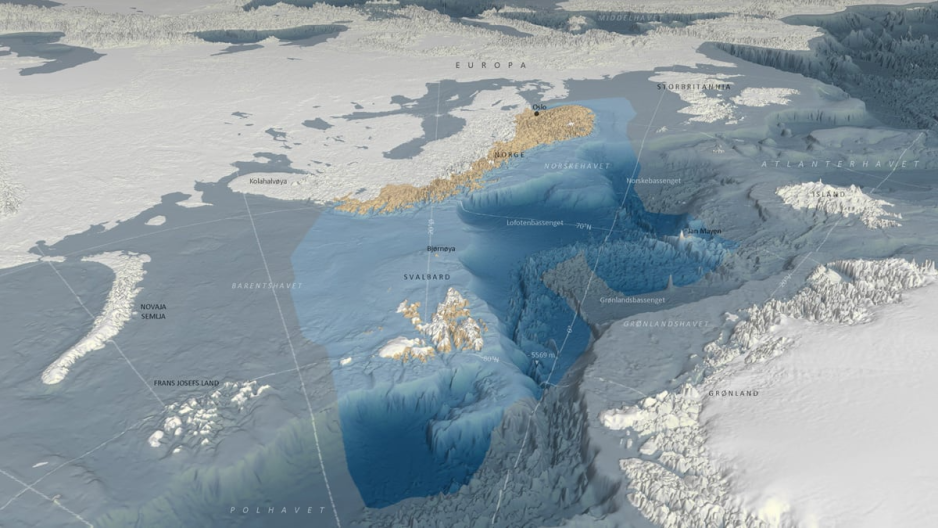
Norway’s central role in northern maritime security with a bathymetric view from the North Pole in the direction of Norway. (Source: Courtesy Norwegian Polar Institute)
New UK-Norway Defense Agreement
In parallel with expanding its submarine fleet, Norway and the United Kingdom last week announced a historic defense agreement as part of which the two countries will jointly operate anti-submarine warfare frigates.
Under the agreement, Norway will acquire at least five of the UK’s new Type 26 Global Combat Ship frigates.
The deal, valued at roughly £10 billion (NOK 135 billion), underscores the two nations’ commitment to defending underwater infrastructure, securing the North Atlantic, and hunting Russian subs.
A major boost
This dual effort, expanding Norway’s own submarine force while cooperating closely with the UK on surface-based anti-submarine assets, signals a major boost to Northern European maritime defense.
It comes at a time of heightened Russian submarine activity out of the Kola Peninsula, raising concerns for NATO about undersea threats to the High North and the Atlantic approaches.
In September three Russian Yasen-class nuclear attack submarines went reportedly unaccounted for after departing from the Zapadnaya Litsa submarine base near Murmansk prompting extensive maritime patrol aircrafts from several Nordic countries in the waters off the Lofoten.
With six highly capable, air-independent propulsion submarines optimised for Arctic and North Atlantic operations, supplemented by a fleet of state-of-the-art frigates, Norway is sending a clear signal of a shifting maritime security posture in Europe’s north.