Arctic Receives No Mention in New White House National Security Strategy, But U.S. Polar Engagement Remains
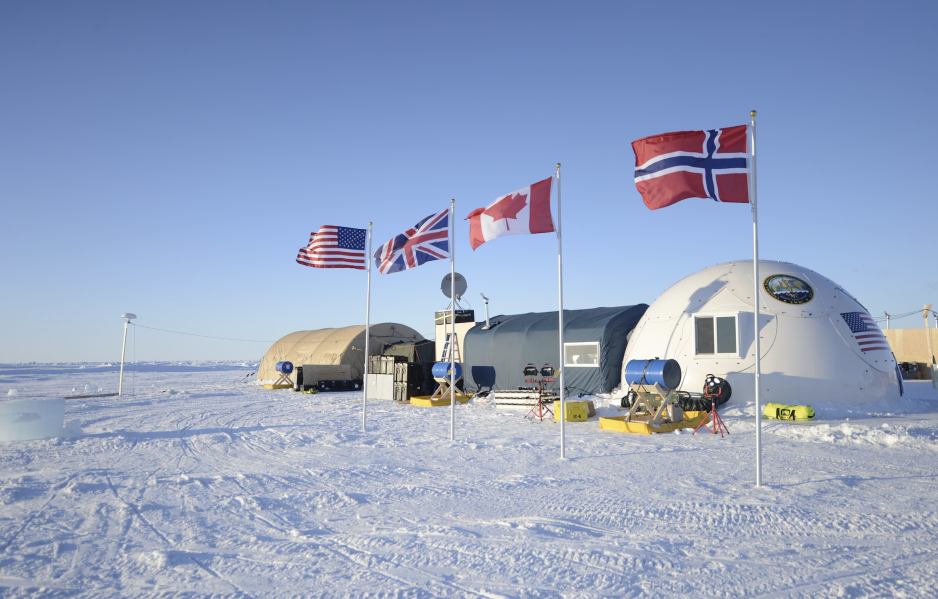
Ice Camp Sargo in the Arctic Circle served as the main stage for Ice Exercise (ICEX) 2016; it housed more than 200 participants from four nations over the course of the exercise. (Source: U.S. Navy / Mass Communication Specialist 2nd Class Tyler Thompson)
The Trump administration’s 2025 National Security Strategy omits a dedicated Arctic section, unlike its 2022 predecessor, but experts say the shift reflects a hemispheric approach—not neglect—with icebreaker acquisitions and the ICE Pact signaling continued U.S. engagement and strategic focus on the North American Arctic.

The U.S. on Thursday released its 2025 National Security Strategy (NSS), under the administration of Donald Trump, shifting focus squarely to what it calls “core foreign policy interests.”
Notably, the Arctic – which was a discrete section in the 2022 National Security Strategy under the previous administration – is absent as a named region in the new document. The omission has stirred discussion about what it means for U.S. Arctic policy.
The Biden-era strategy, devoted a dedicated “Maintain a Peaceful Arctic” chapter integrating security, environmental and diplomatic priorities in the Far North.
Reorganizes priorities
The 2022 approach recognized rapidly shifting geopolitics and climate-driven new opportunities and risks, promising “regular and robust consultation” with Indigenous communities, expanded U.S. presence, and heightened cooperation with Arctic allies.
In its 2025 Strategy, the Administration reorganizes priorities around a hemispheric framework.
It’s not surprising that President Trump’s 2025 National Security Strategy does not address the Arctic directly
Under “What We Want In and From the World,” the document emphasizes that “the Western Hemisphere remains free of hostile foreign incursion or ownership of key assets” and expresses a commitment to “critical supply chains and access to strategic locations.”
Not suprising
That shift implicitly re-frames the North American Arctic – including Alaska, Greenland, and Canada – as part of a broader Western-Hemisphere zone of interest.
“It’s not surprising that President Trump’s 2025 National Security Strategy does not address the Arctic directly, given its explicit emphasis on prioritizing ‘core foreign policy interests’. Nevertheless, the Arctic is directly implicated throughout the document,” said Rebecca Pincus, Senior Fellow at the Foreign Policy Research Institute.
She added that the NSS lays out a “Trump Corollary” to the historic Monroe Doctrine putting the Western Hemisphere – and, by extension, the North American Arctic – at the top of U.S. strategic concern.
“The emphasis on the Western Hemisphere underscores what has long been true about the Arctic: there are major differences between the North American Arctic (in the Western Hemisphere), and the Russian Arctic, and the Northern European/Nordic Arctic,” Pincus continued.

Rebecca Pincus, Senior Fellow at the Foreign Policy Research Institute. (Photo: Wilson Center)
Pushing back China’s influence
Echoing a similar interpretation of the NSS, Elizabeth Buchanan, a polar geopolitics expert at the Australian Strategic Policy Institute, argues that the absence of a named “Arctic” section does not mean the region has been overlooked.
“The NSS25 is actually a clear signal that the Arctic is an established theater within the Trump Administration’s notion of returning to a hemispheric defense strategy,” she said.
She noted the administration is likely to intensify U.S. presence in the Arctic frontier – especially in the North American Arctic – under broader hemispheric defense and supply-chain objectives.
“We should expect Washington to up its presence and throw its weight around in the Arctic frontier - per the hemispheric defense strategy - systematically removing Chinese footprints,” she continued.
Troy Bouffard, Director of the Center for Arctic Security and Resilience at the University of Alaska Fairbanks, also expanded on this aspect of the analysis. He observed that the new NSS implicitly recognizes the Arctic as “a zone of strategic competition and sovereignty importance.”
Also read (the text continues)
“The Arctic, especially for Alaska and U.S. High North interests, is likely to be part of wide-ranging requirements involving U.S. national defense, energy efforts, and geopolitical interest,” he continued.
Engagement beyond North American Arctic
Still, the omission raises questions about U.S. posture outside the North American Arctic – the Nordic and Russian Arctic zones — which may fall outside the narrower hemispheric interpretation. As Pincus noted, “other parts of the Arctic may not be of particular interest to this administration.”
“The emphasis on the Western Hemisphere underscores what has long been true about the Arctic: there are major differences between the North American Arctic (in the Western Hemisphere), and the Russian Arctic, and the Northern European/Nordic Arctic,” Pincus concluded.
Furthermore, one area where U.S. engagement may be lacking posture could be Antarctica.
No withdrawal
“Should Washington also seek to do this in Antarctica - this will be a more challenging task as the west has had its eyes shut to entrenched Chinese power across the unowned continent,” Buchanan asked.
While the 2025 NSS drops a standalone Arctic chapter, it does not necessarily signal U.S. withdrawal from the region but rather a reframing.
The renewed icebreaker build-up and the ICE Pact, together with a hemispheric-first strategic outlook, suggest Washington intends to maintain robust engagement in the North American Arctic, even as its focus (for now) appears to narrow.