Canadian Seaspan Yard Signs Deal For Arctic Security Cutters, Joining US and Finnish Builders
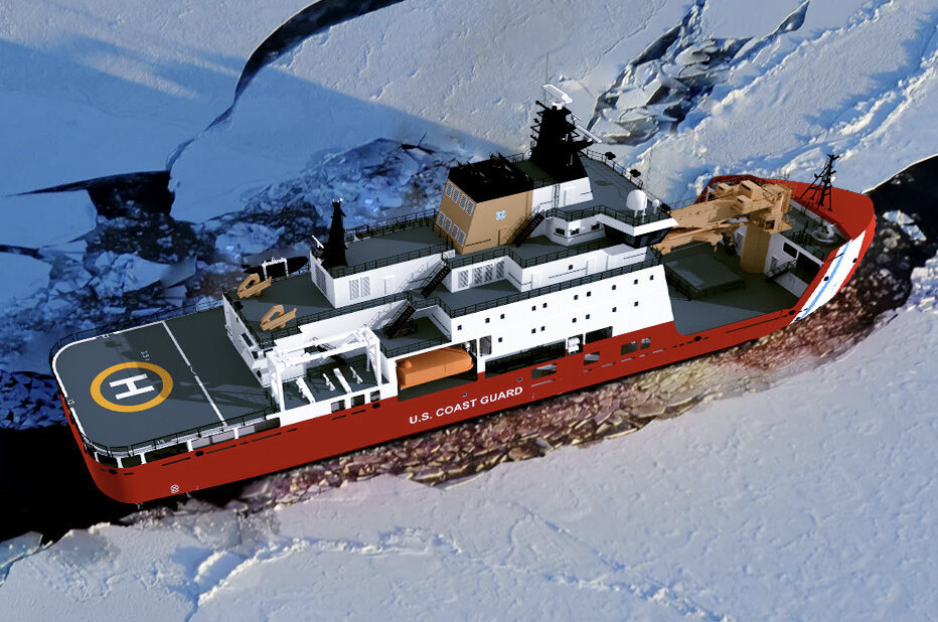
Rendering of Seaspan's MPI icebreaker for the USCG. (Source: Seaspan)
The push for new U.S. icebreakers continues to take shape. Canadian builder Seaspan has now joined the effort by providing its Multi-Purpose Icebreaker design and associated supply chain to American and Finnish shipyards to build six icebreakers. Construction is expected to start in 2026 with initial deliveries by 2028.

Canada’s Seaspan Shipyards has struck a deal with U.S. yard Bollinger Shipyards and Finland’s Rauma Marine Constructions to supply its production-ready Multi-Purpose Icebreaker (MPI) design for the U.S. Coast Guard’s Arctic Security Cutter program, aiming to accelerate delivery of a new generation of polar-capable vessels.
Under the agreement, Seaspan will provide its MPI design along with associated supply-chain packages that enable a rapid production start, the companies said. The program covers six vessels, with two to be built at Rauma in Finland and four at Bollinger’s U.S. facilities.
The collaboration brings together Canadian design and program experience, U.S. shipbuilding capacity, and Finnish Arctic construction expertise at a time when Washington is seeking to expand its polar fleet to meet growing strategic and operational demands in the Arctic.
“The MPI design is a true success story under Canada’s NSS,” Seaspan Shipyards’ CEO John McCarthy said.
“The interoperability resulting from a common design and supply chain between the Canadian and American coast guard fleets will create countless opportunities for collaboration throughout the vessels’ operational lives, aligning with the greater goals outlined in the trilateral ICE Pact framework.”
A true success story under Canada’s NSS
Relying on production-ready design
Seaspan’s MPI design was developed under Canada’s National Shipbuilding Strategy (NSS) and is intended to balance endurance, ice capability, and multi-mission flexibility.
The vessels are designed for sustained operations in first-year ice and challenging shoulder-season conditions, while retaining the range and seakeeping required for long patrols across vast Arctic distances.
The MPI design traces its origins to Canadian Coast Guard requirements for a versatile platform capable of icebreaking, search and rescue, scientific support and logistics.
The vessels are medium icebreakers by global standards, offering a combination of moderate displacement, efficient propulsion, and robust hull form optimized for Arctic operations.
Their ice class allows operations in heavy first-year ice with old-ice inclusions, while avoiding the cost and complexity of the heaviest polar icebreakers.

John McCarthy, CEO of Seaspan Shipyards. (Photo: Seaspan)
Several MPI vessels are already in various stages of construction or planning for Canada, forming part of Seaspan’s large icebreaker orderbook for the Canadian Coast Guard.
Seaspan is currently building multiple polar and ice-capable ships in Vancouver, giving the yard one of the most substantial icebreaker backlogs in the Western world.
A key technical partner on the MPI program has been Aker Arctic, which contributed to hull form development, ice model testing, and performance optimization. The Finnish firm is widely regarded as a global leader in icebreaker design and has played a central role in ensuring the MPI meets demanding ice performance criteria without sacrificing efficiency in open water.
Avoiding pitfalls of the PSC icebreaker
For the U.S. Coast Guard, the agreement is intended to de-risk and accelerate the Arctic Security Cutter program by leveraging an already mature and proven design rather than starting from a clean sheet.
The Arctic Security Cutter program was funded in 2025 by the Trump White House and is expected to deliver a total of 11 vessels to modernize the Coast Guard’s ageing polar fleet. The six vessels covered by the Seaspan–Bollinger–Rauma arrangement form the first tranche.
The remaining five cutters are expected to be built under a separate arrangement, with a contract involving Canada’s Davie and Helsinki Shipyard anticipated to be signed in the near future, according to industry sources.
Bollinger, which acquired former Gulf Coast shipyard assets to expand its federal shipbuilding footprint, will lead U.S. construction, while Rauma’s role will draw on Finland’s long experience building complex ice-class vessels for Arctic and Baltic operations.
The first Arctic Security Cutters based on the MPI design are expected to be ready by 2028, officials said. Once in service, the vessels are intended to operate alongside Canadian and allied icebreakers, reflecting a growing emphasis on interoperability and burden-sharing among Arctic nations as activity in the region increases.