U.S. Signs Contracts With Foreign and Domestic Builders to Finally Launch Long-Delayed Icebreaker Fleet Overhaul
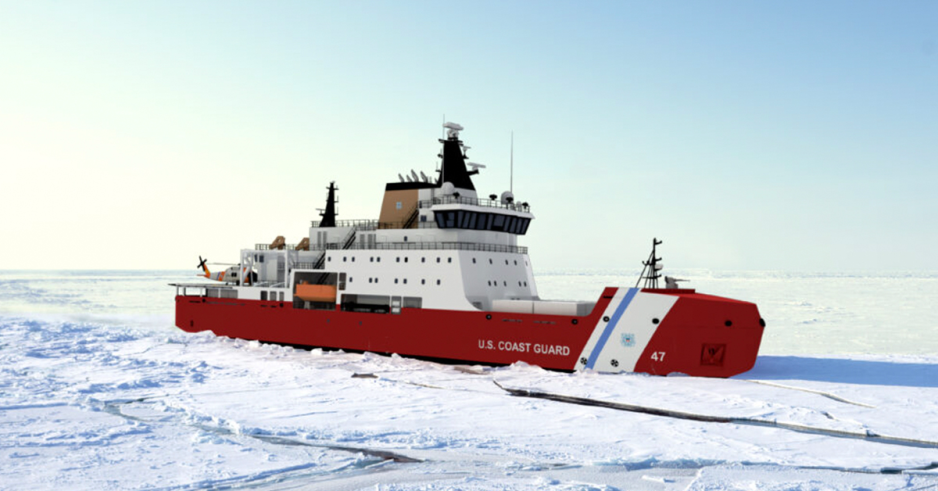
Rendering of future Arctic Security Cutter. (Source: Bollinger)
The United States Coast Guard has signed contracts with Finland’s Rauma Marine Constructions and Louisiana’s Bollinger Shipyards to build six Arctic Security Cutter icebreakers, marking the culmination of a decades-long effort to modernize its aging icebreaker fleet. Two ships will be built in Finland for delivery in 2028. Four more vessels will follow in the United States, with the first domestic cutter due in 2029.

The U.S. Coast Guard awarded two major contracts on December 26 to construct medium polar icebreakers, a move designed to expand U.S. presence in the Arctic and to finally bring the service’s icebreaker fleet into the 21st century.
Rauma Marine Constructions (RMC) Oy of Rauma, Finland, will build two Arctic Security Cutters (ASCs) with the first unit expected to be delivered in 2028, while Bollinger Shipyards of Louisiana will construct up to four cutters at its Houma, Louisiana, facilities, with the first U.S.-built vessel slated for 2029.
The awards come after years of delays in U.S. icebreaker procurement and formalize a strategic international partnership with Finland, one of the world’s leading builders of ice-going vessels.
The contracts, part of a broader initiative under the so-called ICE Pact framework, position the United States to acquire up to 11 Arctic Security Cutters in total over the next decade.
It was the Biden Administration that initiated the ICE Pact in 2024, with up to $8.6 billion in funding secured by the Trump White House as part of the “Big Beautiful Bill” during summer 2025.
The awarded contract marks a historic milestone
“Revitalizing the U.S. Coast Guard’s icebreaking capabilities is crucial for our security and prosperity,” Secretary of Homeland Security Kristi Noem said in a Coast Guard press release announcing the awards. “America has been an Arctic nation for over 150 years, and we’re finally acting like it.”
Arctic comes to forefront
The Arctic has emerged as a strategic priority for Washington, with melting ice opening new shipping routes and increasing competition among global powers for access to natural resources and maritime influence.
The Coast Guard’s existing icebreaking fleet consists of just a handful of aging vessels, leaving the United States with limited year-round capability in the region.
Under the new contracts, RMC will leverage its expertise in icebreaker construction, honed through decades of building vessels for customers around the world, to deliver the first ASCs under the program’s accelerated schedule.
“The awarded contract marks a historic milestone,” said RMC Chief Executive Officer Mika Nieminen.

Mika Nieminen, CEO Global Manufacturing and Supply Chain Executive at Rauma Marine Contructions. (Photo: RMC)
“We secured this significant deal thanks to our expertise and capability to build the ships within the required timeframe. Now it is time for us and our network to prove ourselves and demonstrate that we are worthy of trust.”
RMC will build the cutters at its shipyard on Finland’s west coast, with the Satakunta University of Applied Sciences partnering on workforce training for the project.
Finnish officials highlighted the contract as a major boost for the nation’s maritime sector.
“Finnish shipyards build the world’s best icebreakers and the largest cruise ships,” Finnish Minister of Economic Affairs Sakari Puisto said, noting the agreement strengthens Finland’s competitiveness and export income.
Bollinger partners with RMC
RMC partnered up with U.S.-based Bollinger Shipyards in pursuit of the contracts. Bollinger has built hundreds of cutters for the Coast Guard over more than four decades. The company said the ASC program is one of the most important in the service’s history.
“This program will be Bollinger’s fifth class of cutters built for the Coast Guard, building on our current Sentinel and Polar Security Cutter programs and more than 40 years of experience,” said President and CEO Ben Bordelon.
“With clear direction and an aggressive delivery timeline, our mission is straightforward: leverage our shipbuilding facilities across the Gulf Coast to deliver these cutters on schedule and mission ready on day one.”
The contracts reflect a workshare strategy that taps Finland’s icebreaker heritage to accelerate delivery while building U.S. domestic capacity. Bollinger’s facilities along the Gulf Coast and satellite sites are expected to support construction of the U.S.-based ASCs.
Chance to overcome challenges
The U.S. Coast Guard has long faced challenges in fielding a modern icebreaking fleet. Separately, the Polar Security Cutter (PSC) program, an effort to build heavy icebreakers capable of extended Arctic operations, has been plagued by delays and cost growth.
Also read (the text continues)
The first PSC, originally scheduled for delivery in 2024, has repeatedly slipped and is now expected no earlier than 2030, according to congressional and industry estimates, underscoring the difficulties the U.S. shipbuilding sector has had in producing complex, specialized vessels.
Bollinger is constructing the vessel at its Mississippi-based yard.
That vessel’s design complexity and numerous changes from the original proposed design based on the German Polarstern II, contributed to ongoing delays as well as the fact that no American yard has constructed a heavy icebreaker in more than 50 years.
By contrast, the ASC program’s reliance on a mature, production-ready Multi-Purpose Icebreaker design, developed with Canadian and Finnish partners Seaspan Shipyards and Aker Arctic Technology, is intended to reduce technical risk and accelerate delivery. U.S. Coast Guard officials described the joint venture as critical to meeting “time-sensitive” national security needs in the Arctic.
Admiral Kevin E. Lunday, acting commandant of the Coast Guard, said the ASCs would provide “essential capability to uphold U.S. sovereignty against adversaries’ aggressive economic and military actions in the Arctic,” adding that the cutters would enable the service to defend maritime approaches, secure shipping lanes and respond to crises in the region.
The long-anticipated award of contracts for the ASC icebreakers thus marks a significant milestone in U.S. maritime strategy, ending years of debate and planning over how to rebuild capability in one of the world’s most challenging marine environments.
Yet it also highlights the broader challenge facing U.S. shipbuilding, a sector that has struggled to deliver complex vessels such as the larger Polar Security Cutter on schedule.
The Finland-U.S. cooperation on the ASC program may represent a historical opportunity to transfer expertise, strengthen domestic industrial capacity and finally modernize the nation’s fleet of Arctic icebreakers.
A second batch of contracts to construct up to five ASC led by Canadian-based builder Davie is expected to follow. As with this deal, Davie’s proposal suggests the construction of two vessels at its Finland-based Helsinki Shipyard with three more to follow from its Texas yard.