South Korea Plans First Arctic Container Ship Test Voyage via Russia’s Northern Sea Route
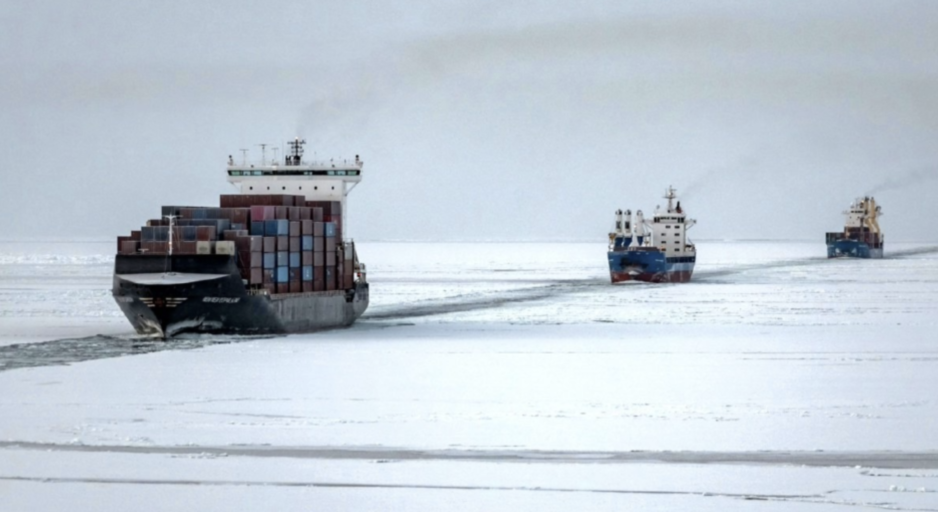
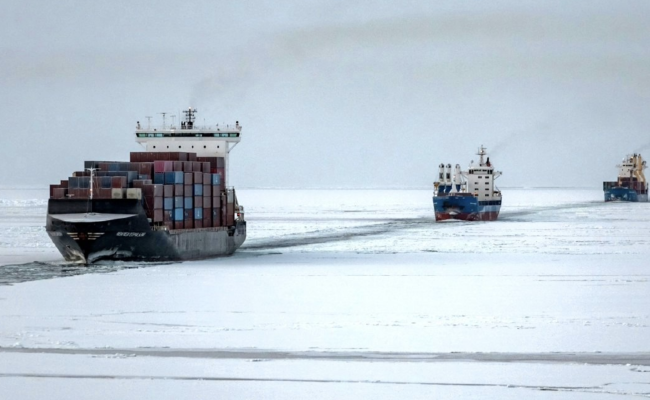
China’s NewNew Polar Bear in a convoy on the Northern Sea Route during eastbound voyage in October 2023. (Source: Rosatomflot)
South Korea is preparing its first-ever container ship voyage through Russia’s Northern Sea Route, testing whether Arctic shipping can reshape Asia–Europe trade. The trial highlights Seoul’s ambitions to turn Busan into an Arctic hub, despite sanctions risks, high insurance costs and lingering geopolitical uncertainty.

South Korea has announced plans to send a container ship through Russia’s Northern Sea Route (NSR) for the first time, signaling Seoul’s ambition to play a larger role in Arctic shipping as melting ice gradually opens a shorter maritime link between Asia and Europe.
The trial voyage would mark South Korea’s inaugural container transit of the Arctic passage and forms part of a broader government push to engage more deeply with emerging polar shipping routes, officials said last week.
“The government plans to operate a 3,000 twenty-foot equivalent unit (TEU) container ship on a trial run from Busan to Rotterdam this year, and support the construction of icebreakers and other polar-class vessels,” acting Oceans Minister Kim Sung-bum said at a press briefing last week.
“We plan to secure a vessel for the trial voyage and pursue consultations with Russia in the first half of the year,” Kim added.
The proposed sailing would run from Busan to Rotterdam via the Northern Sea Route, which tracks Russia’s Arctic coastline.
We will find a way to address both issues
The voyage is expected to take place in September, typically the month with the lowest sea ice coverage, before refreezing accelerates toward late October.
Playing catch-up with China
South Korea’s announcement comes as China has emerged as the most active non-Russian user of the Arctic corridor.
Chinese operators have already dispatched several dozen container ships along the route, industry sources say, gaining valuable experience in ice navigation, permitting and insurance.
That includes a record-setting transit by the container vessel Istanbul Bridge, which sailed from China to Felixstowe in October 2025.
Must obtain permit
By contrast, most Western shipping companies have avoided the NSR in recent years, citing sanctions risks, high insurance premiums, and political uncertainty linked to Russia’s war in Ukraine.

Oceans Minister Kim Sung-bum, Korea. (Photo: Korean Ministry of Oceans and Fisheries)
South Korea broadly aligns with Western sanctions on Russia and has blocked the delivery of several ice-class LNG carriers ordered by Russian companies.
That raises questions over whether Moscow will cooperate with Seoul’s plans, since all vessels transiting the NSR must obtain a permit from a Russian government agency.
Alternative route
“However, since South Korea is also participating in Western countries’ sanctions against Russia, we will find a way to address both issues,” Kim said.
Russian officials have long promoted the NSR as an alternative to traditional routes such as the Suez Canal and have invested heavily in icebreakers, ports, and navigation services.
While Moscow has continued to welcome foreign participation in principle, Chinese shipping firms have been almost the only international operators willing to conduct repeated Arctic transits since 2022.
Also read (the article continues)
Thus South Korea’s interest could be welcomed in Moscow, even given Seoul’s participation in sanctions, as Russia seeks to demonstrate that the Arctic route remains internationally relevant beyond China.
For South Korea, the economic rationale is clear.
The Arctic route from Busan to Rotterdam cuts sailing distance to about 13,000 km from roughly 20,000 km via the Suez Canal, reducing voyage time to around 20 days and lowering fuel consumption.
Arctic as economic driver
Seoul also sees Arctic shipping as a lever to revitalize Busan, the country’s main container port, and transform it into a hub for cargo redistribution from the Arctic to Northeast Asia.
South Korea’s strategic location makes it the first major logistics center for vessels exiting the Arctic en route to Asian markets.
A pivotal role in building the ice-class vessels
As part of a broader effort to revive shipbuilding and the maritime sector, the government recently relocated the headquarters of the Ministry of Oceans and Fisheries to Busan, reinforcing the city’s role as the center of Korea’s maritime policy.
Ice-capable ships
Korean shipyards have already played a pivotal role in building the ice-class vessels that keep much of Russia’s Arctic oil and LNG exports flowing.
Looking ahead, Seoul hopes domestic yards could also produce ice-capable container ships, extending the NSR navigation season. The government has earmarked subsidies of $8 million per ice-capable vessel built domestically.
Despite the potential savings in time and fuel, Arctic voyages remain costly. Kim said maritime insurance for the test voyage could reach $435,000, reflecting risks from ice, remoteness, and geopolitical uncertainty.
It remains unclear whether Chinese operators, which now conduct up to a dozen Arctic container voyages annually, have achieved sufficient economies of scale to operate the route profitably.
Still, Seoul’s planned trial signals that interest in Arctic shipping is spreading beyond China, potentially reshaping future Asia-Europe trade lanes.